![[campubl] e magazine brandbook (1)](https://purple.campubl.com/wp-content/uploads/2025/08/cropped-CAMPUBL-E-Magazine-Brandbook-1-1-50x70.png)
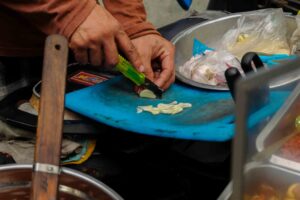
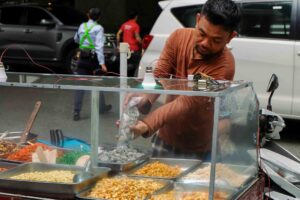
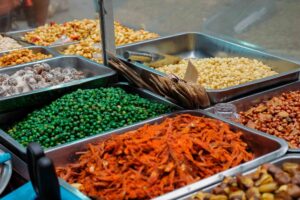
Rush hour paints a restless scene—people striding as if perpetually late, cars blaring their horns, leaving trails of black smoke that linger in the air. This haze envelops Vito Cruz, a street alive with diversity, from hurried LRT commuters to locals who call it home. For 39-year-old Jimuel, Vito Cruz is more than a backdrop; it’s where he spends countless hours under the scorching sun and in the chill of night, selling his modest but colorful offerings: crisp red anchovies, bright green peas, and peanuts still warm from the pan.
Under his boss’s supervision, he was assigned to sell his goods in Vito Cruz, catering to the diverse crowd seeking a quick snack amid their busy lives. He’s been in this business for three years now—an Ilonggo who began street vending on unfamiliar ground, but who now knows Manila like the back of his hand. His route stretches to Malate and Divisoria, but this station remains home.
Mornings begin in Divisoria, scouring stalls for fresh ingredients. By three in the afternoon, he’s under the shadow of the LRT. The oil bubbles and pops as the afternoon heat intensifies, but that doesn’t stop him. “Kailangan hapon kasi ang mga tao malakas [ang daloy],” (“It needs to be in the afternoon since there’s a lot of foot traffic.”), Jimuel said.
He drops peanuts, dried anchovies, and green peas into the fryer, transforming them into crunchy, bite-sized finger foods his customers can enjoy on the go. This routine carries on until 1 a.m. However, work doesn’t end at 1 a.m.—it simply shifts. He packs up his cart, drives toward Malate, and sets up again, ready to serve the city’s late-night crowd. “Alas tres nag-start at natatapos kami mga ala una ng madaling araw para makadami kami,” (We start at 3 p.m. and end at 1 a.m. to sell a lot.”), he said.

The bustle of commuters getting on and off the station fuels his sales, with most customers being students from nearby schools. When the academic calendar pauses, so does the steady stream of buyers. “Matumal pag walang pasukan, mas maganda kapag may pasukan ang paaralan at mga trabaho,” (“Sales are slow when there are no classes; it’s better when school and work are in session.”), he said.
To keep business going on slow days, he relies on variety. His spread includes peeled peanuts, sweet beans, sweet peanuts, tamarind candies, green peas, cornic, dried anchovies, and regular peanuts—each adding color and choice to his display. “Mas maganda kasi tignan pag marami, maraming pagpipilian ang mga tao na bibili,” (“It looks more appealing if there’s variety since customers will have something to choose from.”), he said.
No permit is needed for his cart, and encounters with authorities are rare. “Hindi naman ako nakakaapekto sa kalsada,” (“I don’t disrupt the streets.”), he said.
Still, caution guides his every decision. Even during slow seasons, he chooses to stay rooted in his familiar spot beneath Vito Cruz Station. Moving to a busier area might boost sales, but it could also catch the attention of patrolling officers. For him, consistency is both a shield and a strategy.
By night, Vito Cruz exhales. The frantic tempo eases into a slower rhythm: measured footsteps, the occasional jeep rumble, and the metallic scrape of scoops against tin. The warm, nutty aroma rides the breeze, settling over the worn concrete.
Beneath the yellow streetlamps, Jimuel works with the same quiet focus he had hours earlier. His hands move in a rhythm shaped by years of watching the city shift from day to night.
The city never really sleeps, but for him, it softens. The oil cools, the cart is packed, and the noise of the city fades to a distant hum. As dawn approaches, the memory of warm roasted nuts lingers in Vito Cruz—a trace of the man who has learned to make a living in the space between rush hour and sunrise.